❋ Grandkid Time ❋
Grandma Two Days a Week: Whose Nap Rules Win?
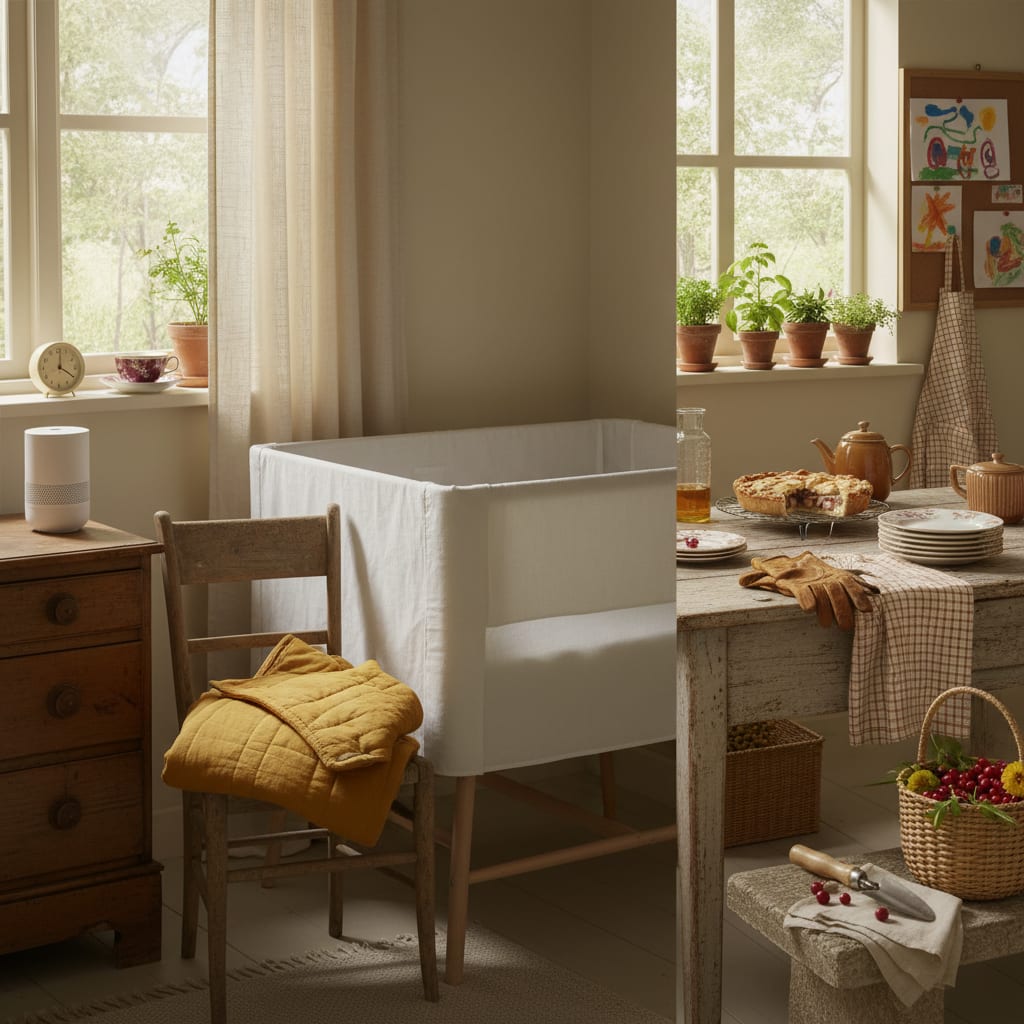
If you have the baby on Tuesdays and Thursdays and you do naps a little differently from his parents, here’s the honest answer: safe sleep must be identical at both houses, total daytime sleep and the last nap of the day should be roughly matched, and almost everything else — where he drifts off, whether you rock him, which song, which blanket — can differ without wrecking anyone’s night. Babies are considerably better at holding two sets of habits than the internet suggests. What they don’t tolerate is a wildly different amount of sleep, or a nap that runs so late it eats bedtime.
I’ve done two days a week for three of my five grandchildren, and the friction was never about safety. It was about me not knowing which parts mattered.
What has to match, and what doesn’t
Think of a baby’s day in three layers.
The safety layer is not a preference and is not mine to adjust. It is identical at every house, every sleep, no exceptions.
The structure layer — how much sleep in total, and when the last nap ends relative to bedtime — is the part that follows the baby home. Get it roughly right and the parents’ evening is fine. Get it badly wrong and they’ll be up at eleven with a wide-awake baby, which is the fastest way to lose Tuesdays.
The texture layer — the room, the sound, the arms, the song, whether you sit there with your hand on his back for twenty minutes because you like it — is yours. This is the part grandmothers worry about and shouldn’t.
The safe-sleep rules that don’t flex
I have to be plain here: a lot of what I did with my own babies is now known to be dangerous, and being cheerful about that would be a disservice.
- On the back, every single sleep. Naps included, at my house included, in the first year. Once a baby rolls over independently you don’t have to keep flipping him, but he is always put down on his back.
- Flat and firm. A crib, bassinet or play yard with a firm mattress and a fitted sheet. Not an inclined sleeper — those were recalled and banned from sale in the US. Not a car seat, swing, bouncer or nursing pillow for a real nap at home.
- Nothing else in there. No bumpers, pillows, quilts, loose blankets, positioners, wedges or stuffed toys. Warmth comes from a sleep sack.
- Not on my chest in the armchair. This is the one that catches loving grandparents, and it’s high-risk precisely because it feels so natural. Cuddle him awake; move him to the crib to sleep.
Every one of those differs from how I was told to do it in the seventies, and I say so out loud to other grandmothers rather than pretending I always knew. The evidence changed; following it now is the same act of love it was then. My full walk-through of what changed and why is in safe sleep rules for grandparents.
Three things worth matching
- Total daytime sleep. Not nap-for-nap, but a similar overall amount. A baby who sleeps ninety minutes more at Grandma’s than at home is a baby who won’t settle at seven.
- When the last nap ends. This is the single most powerful number in the day. Ask the parents for one instruction — “nothing after four” or whatever it is — and hold it even if he’s grizzly.
- The general shape of the wind-down. Not the exact routine; just the same order of a few cues — change, sleep sack, dark room, quiet. Babies read sequence better than they read content.
If you want a sense of what’s normal for the age rather than guessing, Betteroo’s breakdown of how long naps typically run at each age is a useful sanity check before you raise anything with the parents — it saves you arguing from memory, which for most of us is decades out of date.
Four things that can differ
- Where he falls asleep at the start. Rocked, walked, patted, held until drowsy — if his parents are doing independent settling at home and you can’t manage it, say so honestly rather than quietly failing at it. Most babies work out that the arms come out on Tuesdays and don’t on Wednesdays.
- The soundtrack. Their white noise, my ancient kitchen radio, the dishwasher. Doesn’t matter.
- The room. A travel crib in the spare room at mine, a nursery at theirs. Consistency of place matters much less than people expect.
- One motion nap a week. A stroller nap on a walk, or the car on the way back from the store, is not a moral failure. If it becomes the only way he’ll sleep at my house, then it’s worth mentioning — but a nap in the stroller on a Thursday is just a Thursday.
The general principle: a baby holds two sets of associations for two different people quite comfortably. He learns “Grandma does it this way” the same way he learns that Grandma’s house has a dog. What he can’t do is absorb a different quantity of sleep and still be the same child at bedtime.
The Tuesday handover, in one page
Ask the parents for four numbers and one sentence, and put them on the fridge:
- What time he woke up
- How long he can be awake before the next nap
- The latest the last nap may end
- Bedtime
- One sentence on how he goes down
Then send one text at pickup: nap times, how long, and how he ate. Parents who know exactly what happened on Tuesday stop worrying about Tuesday, and a grandmother who volunteers the information never gets asked for it.
My daughter runs her baby’s day on a plan that updates as he grows and lands straight on my phone, which removed the whole negotiation for us. Honest grandmother’s verdict: it’s a scheduling tool, not a magic wand, and babies remain their own people. But we stopped arguing about whether he looked tired.

When my day goes badly
Some Tuesdays the naps fall apart. Two twenty-minute cat naps and a baby who is furious by three o’clock.
What I do: bring bedtime forward rather than clawing the sleep back with a late nap, tell the parents plainly, and don’t apologize for four minutes about it. The grandmother who reports a bad day calmly is the one who keeps getting the baby; the one who hides it is the one who gets a nursery place quietly booked.
And if the two-day arrangement is new, or you’re being asked to take on more, the money-and-expectations side of it deserves a straight conversation — I’ve written mine down in babysitting grandchildren: ground rules that work. The nap-specific setup, from the crib to the room to the routine, is in baby sleep at grandma’s house.
FAQ: two houses, two sets of nap rules
Does a baby need exactly the same nap routine at grandma’s house?
No. The safe-sleep rules must be identical, and total daytime sleep plus the timing of the last nap should be close. The room, the sound, the song and how he’s settled can differ without harming anything.
Will being rocked to sleep at grandma’s ruin sleep training at home?
Usually not. Babies form separate associations for different caregivers and places, and one or two days a week rarely undoes what happens the other five. If the parents are mid-way through a specific plan, ask them directly rather than guessing.
What if a nap at my house runs too late?
Wake him at the time the parents gave you, even if it feels cruel. A late nap that pushes bedtime past its usual point costs the parents the evening, and it’s the one instruction worth being strict about.
Can I let the baby nap in the stroller or car on my days?
Occasionally, yes — a walk that ends in a nap is fine. It shouldn’t become the only way naps happen at your house, and at home a real nap belongs on a firm flat surface in a crib or bassinet.
How much should I tell the parents about the day?
Three lines at pickup: when he napped, how long, and how he ate. Volunteering it prevents almost every anxious question, and it makes the bad days easy to mention because the good ones were reported the same way.