❋ Grandkid Time ❋
25 Activities for Grandparents and Grandchildren
The most useful way to pick an activity with a grandchild isn’t by their age — it’s by how much energy the two of you have between you today. A grandmother with a good night’s sleep and a four-year-old who has been in the car for an hour need something entirely different from the same pair at four in the afternoon. So here are 25 activities sorted into gears: full throttle, steady work, low battery, and the ones you can do from a chair with your eyes half shut. Every one has been run on my own five, and none needs tickets.
Sort by energy, not by age
Age-sorted lists are how you end up promising a scavenger hunt to a child who needed a story, or offering a story to a child who needed to run. Children broadcast their energy level constantly — the volume, the bouncing, the sudden interest in the dog — and matching it is most of the skill.
The other half of the skill is being honest about your gear. There is no prize for hosting a treasure hunt on a day your knees have opinions, and children are far happier with a genuinely present grandmother doing something small than a martyred one doing something big.
Full throttle: when you’re both wound up
- Obstacle course built from cushions, chairs and a broom laid across two books. Time them. Time them again. That’s twenty minutes.
- Car wash for the ride-on toys — bucket, suds, old toothbrush. Expect everyone to be wet.
- Balloon volleyball over a string tied between two chair backs, with the one rule that the balloon must not touch the floor.
- A “collect ten things” walk with a paper bag and a target list of textures rather than objects: something rough, something soft, something cold.
- Digging a hole, anywhere it’s allowed. There is no upper age limit on this and no explanation for it.
- Chalk everything with a bucket of washable sidewalk chalk — a driveway hopscotch, a road for scooters, a life-size outline of each person.
Steady work: jobs done side by side
This is the middle gear and the best one. Small children want employment far more than they want entertainment.
- Baking something with an unmissable smell — the point is the kitchen, not the cookie.
- Snapping green beans or shelling peas into a bowl, which occupies small hands for astonishing lengths of time.
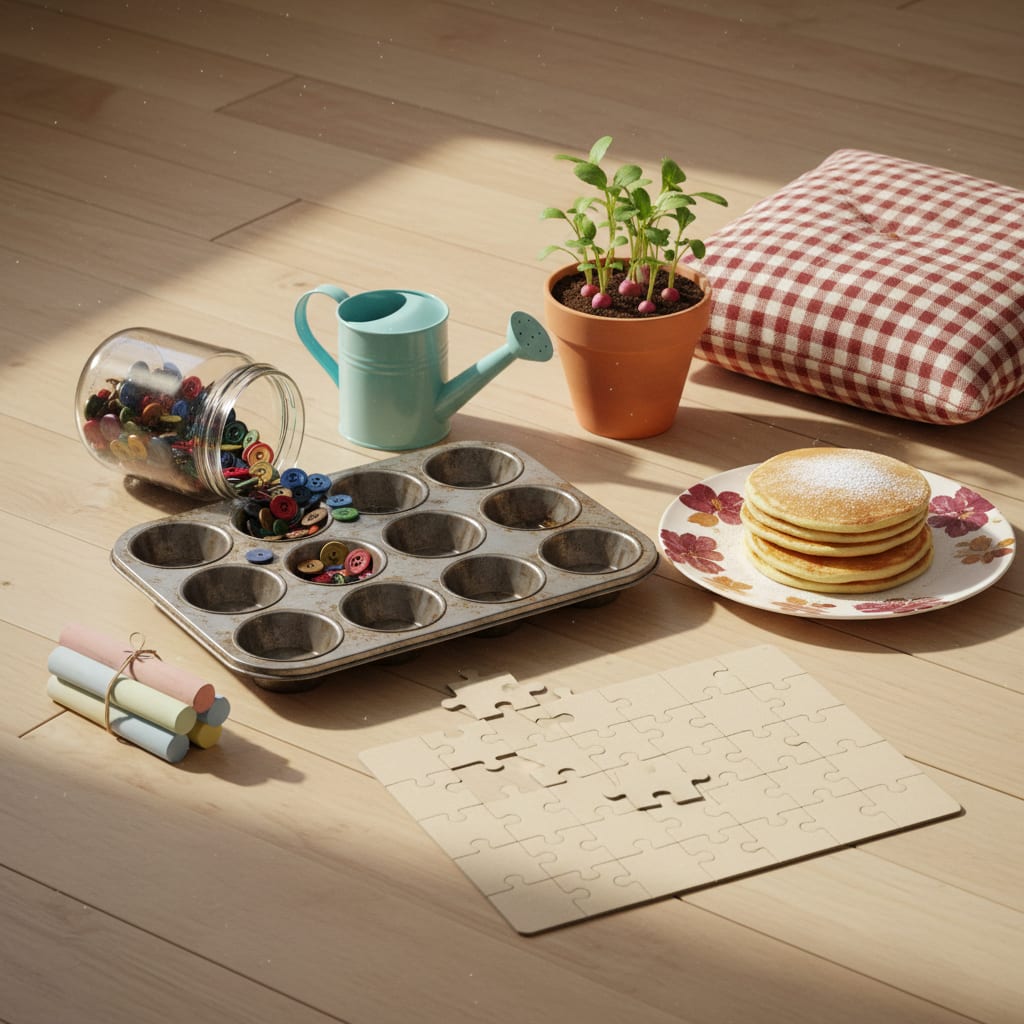
- Sorting the button jar by color, then by size, then by a system only the child understands.
- Washing plastic dishes at the sink on a chair, with a towel underfoot.
- Planting something fast — radishes, cress, sunflowers — and then checking it every single visit.
- Repotting houseplants together, which is legitimate messy fun with a genuinely useful outcome.
- Pairing socks from the clean laundry, turned into a race.
- Polishing the good shoes, which small children find inexplicably glamorous.
- Making a bird feeder from a pinecone, nut-free butter and birdseed, then hanging it where you can both watch it.
Anything you already do yourself belongs in this gear too. The activities that turn into a lifelong thread between the two of you are usually your own hobbies, scaled down — I’ve sorted which ones work at which age in hobbies to share with grandkids.
Low battery: quiet, seated, still fun
- Old photo albums, with commentary. “Was that MY mommy?” is the most reliable sentence in grandparenting.
- A jigsaw puzzle left out on a side table for the whole visit, added to in passing rather than finished in a sitting.
- Drawing at the same table, both of you, no comment on each other’s work.
- Card games with real rules — Go Fish, Snap, Old Maid — and real losing.
- Reading with the child doing the sound effects, which converts a passive story into their job.
- The interview: they ask you about “the olden days” and you answer properly. Record it on your phone. This is the one families are grateful for later.
When there’s nothing left in either of you
- An indoor picnic on a blanket by the window, food you didn’t cook, no table manners in force.
- A “museum” of their own drawings, taped along a hallway, with you as the paying visitor.
- A bath with kitchen equipment in it — measuring cups, a sieve, a whisk — which buys a completely peaceful half hour.
- Watching the weather, unironically. Rain against a window is a genuine activity for a small child and requires nothing from you but company.
For a full day that has to run entirely indoors, I’ve mapped how to pace it hour by hour in rainy day activities with grandkids — the order you spend the energy in matters more than the individual ideas.
Building your own short list
Twenty-five is a menu, not a program. What actually works is choosing five and doing them so often they become the child’s idea of your house: the button jar, the pancake shape, the walk to the same corner, the album on the same shelf. Repetition is what turns an afternoon into a childhood, and it’s also considerably easier on a grandmother than constant novelty.
Keep the list where you can see it. Mine lives on the inside of a kitchen cupboard door, because at three-thirty on a wet Tuesday nobody can think of a single thing to do. If you’d rather browse by age than by energy, the age-sorted version of the same philosophy is my list of things to do with grandkids from birth to six.
FAQ: activities for grandparents and grandchildren
What activities can grandparents do with grandchildren indoors?
Side-by-side jobs work best: baking, sorting, washing plastic dishes, snapping beans, repotting plants. When energy is low, photo albums, a puzzle left out, card games and an indoor picnic carry an afternoon comfortably.
What can grandparents do with grandchildren with limited mobility?
Everything in the seated gear — albums, drawing at the same table, card games, interviews about the old days, reading with the child doing the sound effects. None of it requires standing, and children rate it as highly as the running-about kind.
How do you entertain grandchildren of different ages together?
Run one project with age-sized jobs: the baby watches from a high chair, the toddler dumps and stirs, the older child measures and reads the steps. One activity, three roles, nobody excluded.
How often should activities change?
Rarely. Children attach to rituals far more than to novelty, so five repeated activities beat twenty-five one-off ones. Save new ideas for the days the usual ones aren’t landing.
What if the grandchild only wants a screen?
Offer a job rather than an alternative entertainment — stirring, watering, sorting, carrying. Being needed beats being amused, and it sidesteps the negotiation entirely.