❋ Grandkid Time ❋
Baking With Grandkids: Recipes That Survive Helpers
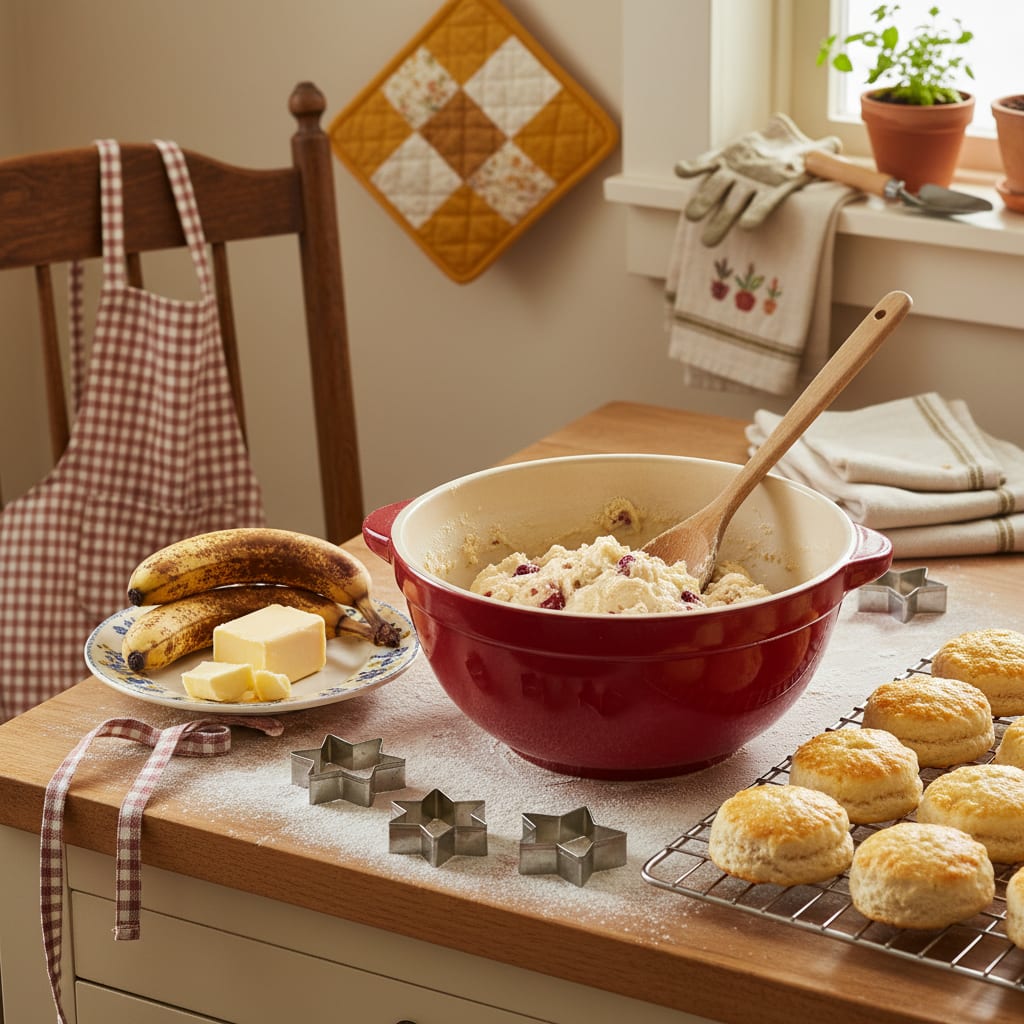
Baking with grandkids goes well when you pick the recipe for the helper, not for the result. Choose something forgiving — a dough that doesn’t mind being over-handled, a batter that doesn’t collapse if it sits, a shape that looks charming when it’s lopsided — and give the child one real job at a time. Drop biscuits, no-bake oat balls, banana bread and simple shortbread all survive enthusiastic help. Puff pastry, meringue and anything requiring a light hand do not. Below: what each age can actually do, four recipes that hold up, and the two rules that keep the parents on your side.
The mess-tolerance tiers
Before you preheat anything, decide which grandmother you are today. I run three tiers and pick one out loud before the aprons come out, because half of kitchen crankiness is a grandma who agreed to a project she hadn’t the patience for.
Tier one — the flour-everywhere day. Rolling, cutting, sprinkling, the counter dusted white. Best on a day you were going to mop anyway. This is where the memories get made, and where a cup of flour ends up in your shoe.
Tier two — the one-bowl day. Everything happens inside a single large bowl on a towel. They stir, they pour from small pre-measured cups you filled, they lick the spoon at the end. Ninety percent of the joy at ten percent of the cleanup.
Tier three — the assembly day. You bake alone in the morning; they decorate in the afternoon. On a low-energy day this still counts.
Announcing the tier first is the best trick I brought from thirty-one years of classrooms: children accept nearly any limit that arrives before the activity rather than during it.
What a child can really do, one to six
- Ones. A high chair beside you, their own bowl, a wooden spoon and a handful of oats to stir. That is the whole activity and it is genuinely enough.
- Twos. Pouring from a small cup you filled, stirring, pressing a cookie cutter down with a flat palm, mashing bananas with a fork. Twos love a job with a satisfying end.
- Threes. Sprinkling, spooning batter into liners, brushing melted butter, rolling dough into balls. Threes repeat the same step twenty times happily, which is exactly what oat balls need.
- Fours. Cracking eggs into a separate small bowl first, so shell is a two-second fix instead of a ruined batter. Measuring with your hand steadying the cup. Kneading.
- Fives and sixes. Reading the steps aloud, rolling and cutting alone, a child-safe nylon knife for soft things, setting a timer, choosing what to make. A six-year-old can more or less run a batch of drop biscuits with you as consultant.
If you want more kitchen-adjacent projects for the same ages, my age-sorted list of things to do with grandkids covers the days when baking isn’t in you.
Four recipes built for helpers
Drop biscuits. No rolling, no cutting, no chilling. Flour, baking powder, salt, cold butter rubbed in, milk stirred through, dropped in rough spoonfuls on a tray. Overworking makes them tougher but not inedible, so enthusiastic mixing costs you very little — and they’re done in about fifteen minutes, which matches the helper’s attention span.
No-bake oat balls. Oats, a nut or seed butter, honey or maple syrup, something sweet stirred through. No oven, no eggs, no waiting. Rolling the balls is the activity, and threes will do it until the bowl is empty. Check about nuts before you buy anything.
Banana bread. Overripe bananas do the heavy lifting, the batter is nearly impossible to ruin, and a two-year-old with a fork and three black bananas is fully employed for ten minutes.
Shortbread. The traditional ratio is one part sugar, two parts butter, three parts flour by weight, and that is the entire recipe — which means a five-year-old can genuinely follow it. It presses into a pan with fingers, so no rolling pin unless you want one.
Things I no longer attempt with helpers: pie crust, cookies that need chilling twice, anything folded, royal icing. The disappointment when a fussy recipe fails isn’t worth the ambition.
Setting up so you spend the day saying yes
The difference between a lovely afternoon and a fraught one is prep done before the child walks in.
Measure everything into small bowls first. Cooking shows have done this forever for a reason: it turns the recipe into a series of pour-and-stir jobs a child can do without waiting, and waiting is what turns helpers into wreckers.
Get them to counter height and stable. A dining chair is how most of us did it, and also why most of us have a story about a fall. A toddler tower like the Guidecraft Kitchen Helper has rails on all four sides and folds flat between visits — the one piece of kitchen equipment I’d actually tell a grandmother to buy if grandchildren visit regularly.
Give them a real tool rather than a pretend one. A set of Curious Chef nylon knives will cut a banana or a stick of soft butter and will not cut a finger, and a four-year-old handed a real job with a real tool behaves noticeably better.
Put a damp towel under the mixing bowl so it doesn’t travel, and hand them a cloth of their own. Children given a cleaning cloth mysteriously make less mess.
Two rules the parents will thank you for
Nobody eats the raw dough or batter. This is the rule that has genuinely changed since our children were small, so I’ll be firm about it. Raw flour and raw eggs can both carry bacteria, and public health agencies now say plainly not to taste uncooked dough or batter — including the “just a fingerful” version we all grew up on. Promise the spoon after baking instead, and build no-bake recipes from ingredients that are safe uncooked.
Ask about allergies and food rules before you shop, every single time. Not at the counter with a toddler on a stool. Nut butters, honey for anyone under one, sesame, dairy, dye — these are the parents’ territory, and anything medical belongs with the child’s own doctor, not with grandma’s memory of what her children ate. Asking takes one text and removes the only version of this afternoon that ends badly.
When it goes sideways
It will. The eggs will go on the floor and somebody will cry about the shape of a cookie. My rule is that the batch belongs to the child: I don’t fix their lopsided cookies, and I don’t quietly re-roll their dough while they’re not looking. Children can tell, and the correction lands as “you did it wrong” no matter how kindly you meant it.
If the whole thing collapses fifteen minutes in, stop. Put it in the fridge, go outside, come back to it or don’t. A ruined afternoon costs more than a ruined batch, and there’s always next week. For a fallback that needs no oven at all, rainy day activities with grandkids has the rest of my indoor repertoire, and the kitchen rituals in my grandmother-granddaughter activities piece are all built to be repeated rather than perfected.
FAQ: baking with grandkids
What’s the youngest age worth baking with? About eighteen months, when stirring, mashing and pressing become real work rather than mess for its own sake. Younger than that, a bowl of oats and a spoon beside you is the honest version.
How do I keep a toddler and a six-year-old both busy? Give them different jobs on the same recipe. The six-year-old measures and rolls; the toddler mashes, sprinkles and presses the cutter. Two recipes at once with two ages is how grandmothers end up shouting.
Can we make the dough ahead so the visit is shorter? Yes, and it’s often the better plan. Mix and chill the day before, and the visit is just rolling, cutting and eating — the parts children actually care about.
Should I send the baking home with them? Send half, keep half. Handing over a whole tray of cookies at 5 p.m. makes you popular with the child and much less so with the parent trying to get dinner in.
What if the parents limit sugar? Bake around it rather than negotiating at the door. Oat balls, banana bread and plain shortbread are all easy to make less sweet, and a grandmother who respects the rule gets asked again.