❋ Gifts & Gear ❋
The Best Toys to Keep at Grandma's House
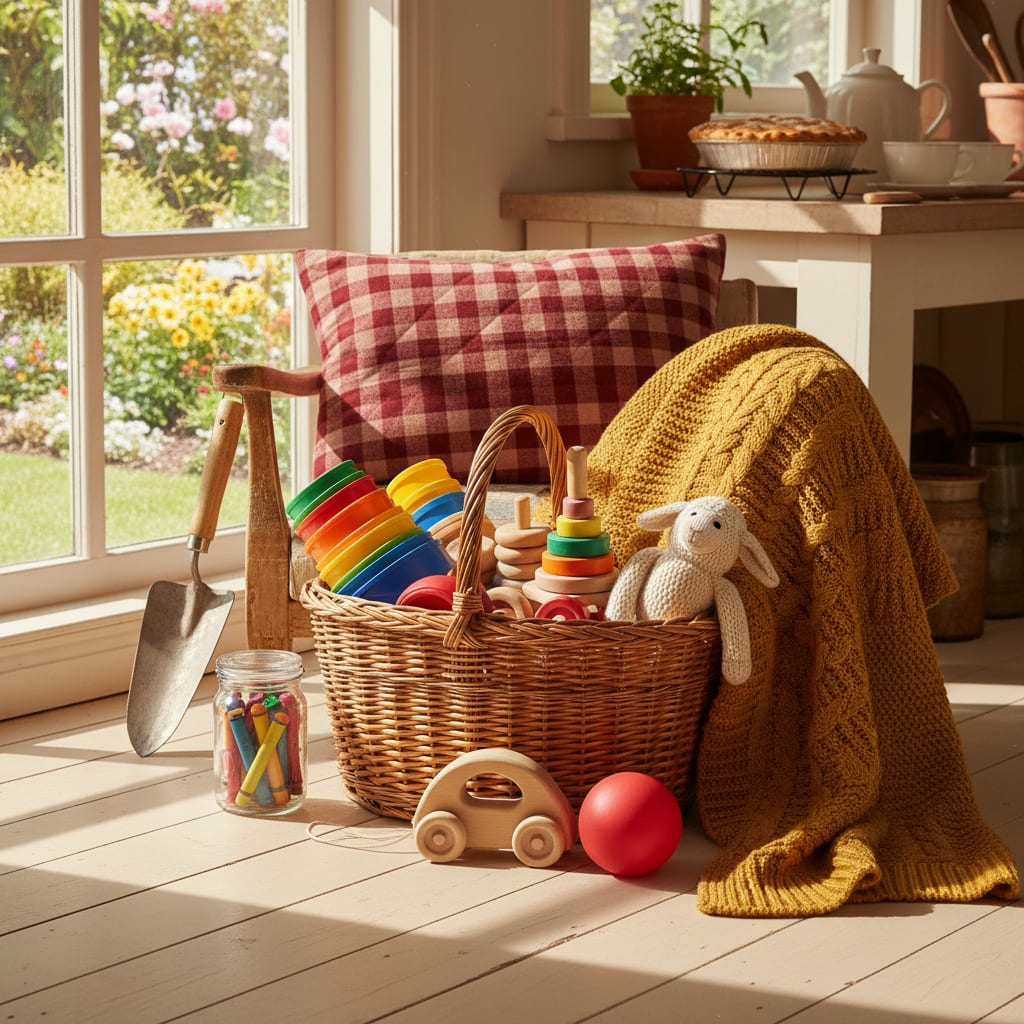
The best toys to keep at grandma’s house fit in one basket, not one room — six to ten open-ended things that get rotated rather than accumulated. A small, changing selection holds a child’s attention far longer than a wall of plastic, it fits in a cupboard between visits, and it doesn’t make the parents dread the car ride home. Here’s the shelf I’ve settled on after five grandchildren, sorted by age, with the things I’ve stopped buying at the end.
The rotating-basket rule
Keep about eight toys out and the rest in a lidded box in the closet. Swap two or three every few weeks, and a two-year-old greets a wooden puzzle she last saw in April as though it were brand new. This single habit does more for the quality of an afternoon than any purchase.
The toys that survive rotation share a trait: the child does the work, not the toy. Blocks, cups, cars, dolls, crayons, a basket of scarves. Anything that lights up, sings and moves by itself gets three minutes of delight and then sits there wanting batteries.
Babies: 0 to 12 months
Babies need very little, and most of what they need is you. Keep a soft ball, a few rattles or teethers, a small unbreakable mirror, and a set of stacking cups — an eight-cup set costs a few dollars and stays useful from about nine months until they’re four, first for knocking down, later for counting and for the bath.
Add board books with thick pages and high-contrast pictures, and a floor blanket to put it all on. If you want to understand why the plainest things hold a young baby best, Betteroo’s guide to what actually holds a newborn’s attention explains it well — and it will save you money. One caution that applies at every age below three: nothing small enough to fit through a toilet-roll tube, which rules out marbles, small magnets and loose button batteries entirely.
Toddlers: 1 to 3 years
This is the golden age of the toy basket. My core set:
- LEGO DUPLO Classic Brick Box — the 65-piece box suits 18 months and up, and the same bricks are still in play at five.
- Wooden building blocks — a hundred plain blocks in four colors, which become towers, roads, walls and, in my kitchen, an elaborate cookie factory.
- A push-along or ride-on — anything with wheels that moves when the child moves it.
- A shape sorter and a chunky-knob puzzle — quiet, self-correcting, endlessly repeated.
- A doll or soft animal with a blanket — the caring games start early and matter more than any educational claim on a box.
- A basket of household oddments — measuring spoons, a whisk, empty tins, scarves. Free, and reliably more popular than the expensive things.
Big kids: 3 to 6 years
Older grandchildren want to make things. Magna-Tiles — a 32-piece classic set, rated three and up because of the magnets inside — are the one premium toy I’d buy again without flinching; they get built, knocked down and rebuilt across a whole rainy afternoon. Add a proper art drawer: chunky crayons, washable markers, a ream of plain paper, safety scissors, glue sticks, and a tub of Crayola Air-Dry Clay for the handprint keepsakes that turn into Christmas presents.
Then two cheap heroes. A pack of Water Wow reusable pads — paint with plain water, dry, repeat — travels in the car, the restaurant and the doctor’s waiting room. And a simple first board game teaches turn-taking, losing, and the fine art of not flipping the table, which is more or less the whole curriculum at four.
Dress-ups belong here too, and they cost nothing: a hat, a scarf, a handbag, an old pair of your shoes. Every grandchild I have owns a dragon costume and prefers my apron.
What I’ve stopped buying
Anything licensed and loud, because the child outgrows the character before the batteries die. Enormous plastic items the parents have nowhere to store. Craft kits with forty tiny pieces that make exactly one thing. Toy sets sold by age band with a long list of skills on the box — a set of blocks does all of it. And a personal grudge: the toys that sing a nine-second song on a loop, which I now decline as a matter of policy.
One more rule, learned the hard way. Ask before buying anything large, and never send a big toy home without warning — a grandmother who fills a small apartment with plastic is not being generous, she’s outsourcing a problem. Keep the big things at your house, where they’re a treat, and read things to do with grandkids for the half of the afternoon that needs no toys at all. On the wet days, my rainy day activities list does the heavy lifting, and the rest of the grandma’s-house shopping is in baby essentials to keep at grandma’s house.
FAQ: toys at grandma’s house
How many toys should grandma keep?
Six to ten out at a time, with a reserve box in the closet to rotate from. A small changing selection holds attention better than a large static one, and it fits back in a cupboard when the grandchildren go home.
What toys work for a wide age range of grandchildren?
Blocks, DUPLO, stacking cups, art supplies and dress-ups all stretch from toddler to school age, which matters when cousins of different ages visit together. Check the age rating on anything with magnets or small parts before the younger ones are on the floor.
Should I keep toys at my house or send them home?
Keep them at yours. Toys that live at grandma’s stay novel, cost the parents no storage space, and give the grandchildren a reason to look forward to the drive. Ask before sending anything large home.
Are secondhand toys safe for grandchildren?
Often yes, and thrift shops are wonderful for wooden toys and puzzles — but check for recalls, missing pieces, loose small parts and battery compartments that don’t screw shut. Skip secondhand car seats, cribs and anything padded for sleep entirely.