❋ Grandkid Time ❋
Toddler-Proofing Grandma's House, Room by Room
Toddler-proofing grandma’s house is quicker than you fear and different from what you did in 1987. The fastest way to start is to get down on your knees at the front door and crawl the route a toddler would take — you will find, at eye level, three things you have walked past for a decade. The other half of the job is grandparent-specific: our houses hold medication, hot drinks, sewing baskets and heavy old furniture that a modern childproofed home doesn’t. Here’s the room-by-room pass I do before any small visitor arrives.
The ten-minute crawl
Do this once, properly, and the room-by-room list below becomes a checklist rather than a discovery process. On your hands and knees, from the front door through every room the child will enter, look for: anything small enough to swallow, anything dangling, anything that tips, anything hot, and anything that opens.
The single most-missed item in a grandparent’s house is the handbag on the floor by the armchair. Pills, mints that look like pills, coins, keys, a nail file, a lighter — all of it at exactly toddler height. Bags go up high the moment the doorbell rings, and that includes visiting friends’ bags.
Living room and hallway
Anchor the furniture. Tall bookcases, dressers and televisions on stands are the serious one — a climbing toddler can tip a heavy old piece, and antique furniture is heavier than modern flat-pack. A pack of furniture wall straps costs less than dinner and takes an afternoon to fit.
Cover the outlets and gather the cords. Cheap outlet plugs handle the sockets; lamp and phone cables get tucked behind furniture. Looped window-blind cords are a strangulation hazard — cut the loop or fit a cleat and wind them up out of reach, every window, not just the ones near the crib.
Then the small stuff. Coffee-table candles, potpourri, glass ornaments on low shelves, the fire and its tools, and hot mugs left within arm’s reach on a side table. Button batteries deserve special mention: the coin-sized ones in remotes, hearing aids, scales and greeting cards can cause severe internal injury if swallowed, so tape the compartments shut and keep spares locked away, not in a kitchen drawer.
The kitchen
Latch the cabinets that hold cleaning products, dishwasher tablets and alcohol — or better, move all of it up high and leave one low cabinet full of plastic bowls and wooden spoons as a decoy, which buys you twenty minutes of cooking time. Turn pot handles inward, use the back burners, and keep the kettle cord short and pushed back.
Watch the trash bin, the knife block, the plastic bags, and the fridge magnets small enough to swallow. And keep the high chair away from the counter edge — a toddler who can reach a counter can reach whatever is on it.
Bathrooms and bedrooms
Medication is the grandparent hazard, full stop. The daily pill organizer on the nightstand is the most dangerous object in most grandparents’ houses: no child lock, bright colours, and it rattles like a toy. It goes in a locked or high cupboard between doses, along with vitamins, supplements, creams and anything in a handbag.
Set the water heater to a safe temperature and always test bathwater with your wrist. A toilet lid lock is worth it for the crawling age — small children can drown in very little water, and never leave a bucket, bath or paddling pool standing full. Then the bedroom sweep: sewing baskets, jewellery with small beads, hearing-aid batteries, reading glasses, and the nightstand drawer nobody has opened since 2011.
If a grandchild sleeps over, the sleep space needs the same care as the rest: a firm, flat, bare crib for babies, and for the older ones, a floor-level bed or a rail agreed with the parents. Parents vary a lot on when a child leaves the crib, and it’s worth knowing what makes a toddler ready for a bed before you buy anything — an early promotion at grandma’s house causes chaos back home.
Stairs, doors and the garden
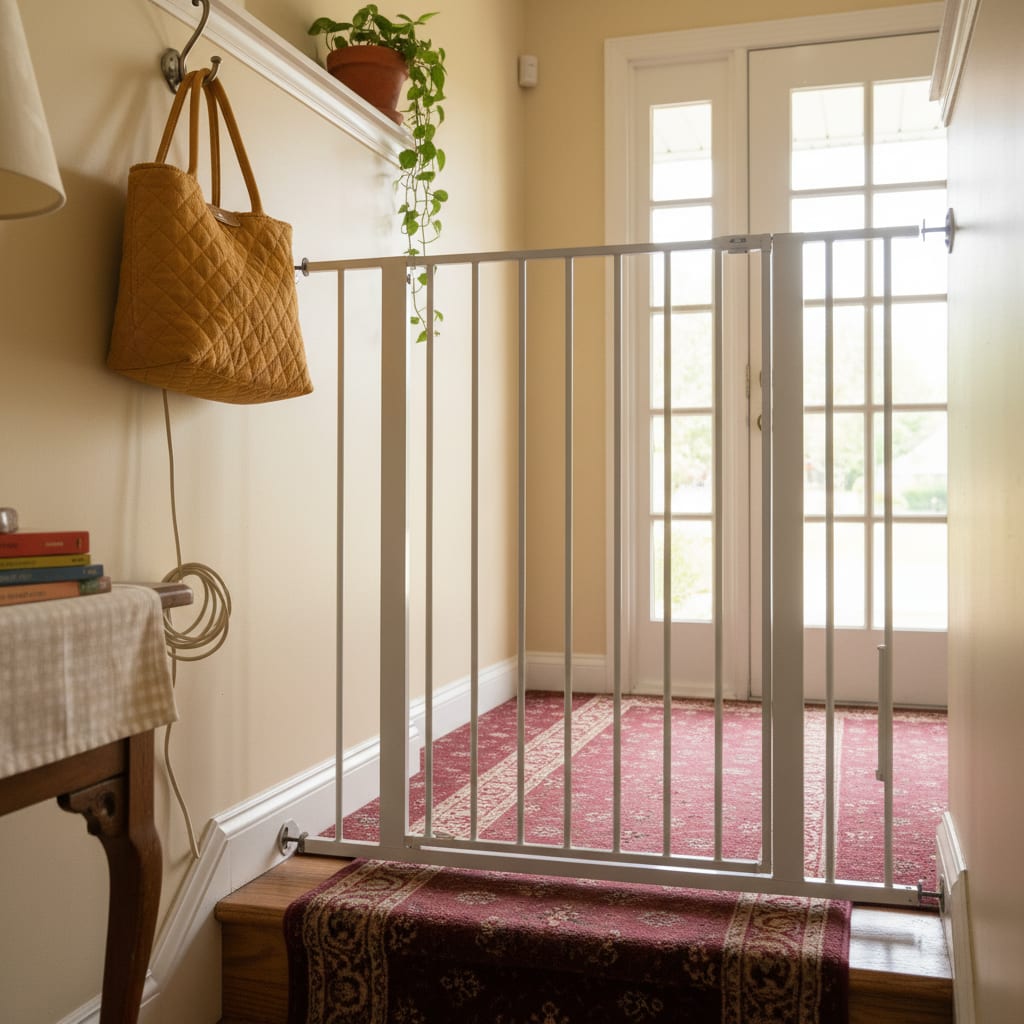
Stairs need gates, and the type matters: a pressure-mounted gate like the Regalo Easy Step is right for doorways and the bottom of stairs, but the top of a staircase needs a hardware-mounted gate screwed into the wall, such as the Cardinal Gates Stairway Special. A pressure gate at the top can be pushed out; this is the one place not to economise.
Outside, check the gate latch, the pond or water butt, the garden chemicals and tools in the shed, and the plants — several common garden favourites are toxic if chewed, so look up anything you’re unsure of rather than guessing. Add door pinch guards on the doors that slam, and a lock or chain high on any door leading to a driveway or road.
The part no gadget replaces
Every safety catch in the world is worth less than an adult in the room. Supervision is the actual system, and the equipment just buys you the seconds when you turn around. Keep the emergency numbers and the poison control number written down somewhere visible — you will not want to be searching for them one-handed.
Two final grandmother notes. Redo the crawl each year, because a walker finds different trouble than a crawler and a climber finds all of it. And tell the parents what you’ve done — it reassures them enormously, and it’s the reason my babysitting ground rules conversation goes so smoothly now. The gear side of the same job is in baby essentials to keep at grandma’s house, and the overnight version is in my sleepover at grandma’s checklist.
FAQ: childproofing a grandparent’s house
What do grandparents most often forget to childproof?
Medication — especially the daily pill organizer left on a nightstand or table — and handbags left on the floor. Both sit at toddler height, look interesting, and are usually the only things in the house with no lock at all.
Do I need to childproof if the grandchildren visit rarely?
Do a reduced version: anchor the tall furniture, secure the medication, cover the outlets in the rooms they’ll use, gate the stairs, and lift the handbags. Those five take an afternoon and cover the hazards that cause the most serious injuries.
What kind of stair gate should I buy?
Hardware-mounted, screwed into the wall, for the top of stairs. Pressure-mounted gates are fine for doorways and the bottom of a staircase, but they can be pushed loose, which is exactly the wrong failure at the top of a flight.
At what age can I stop toddler-proofing?
Gradually, from around four, and by feel rather than by birthday. Medication, chemicals, water and button batteries stay locked away far longer — well into school age, and honestly, for good.