❋ Grandkid Time ❋
Baby Sleep in a Multigenerational Home: Grandma's Guide
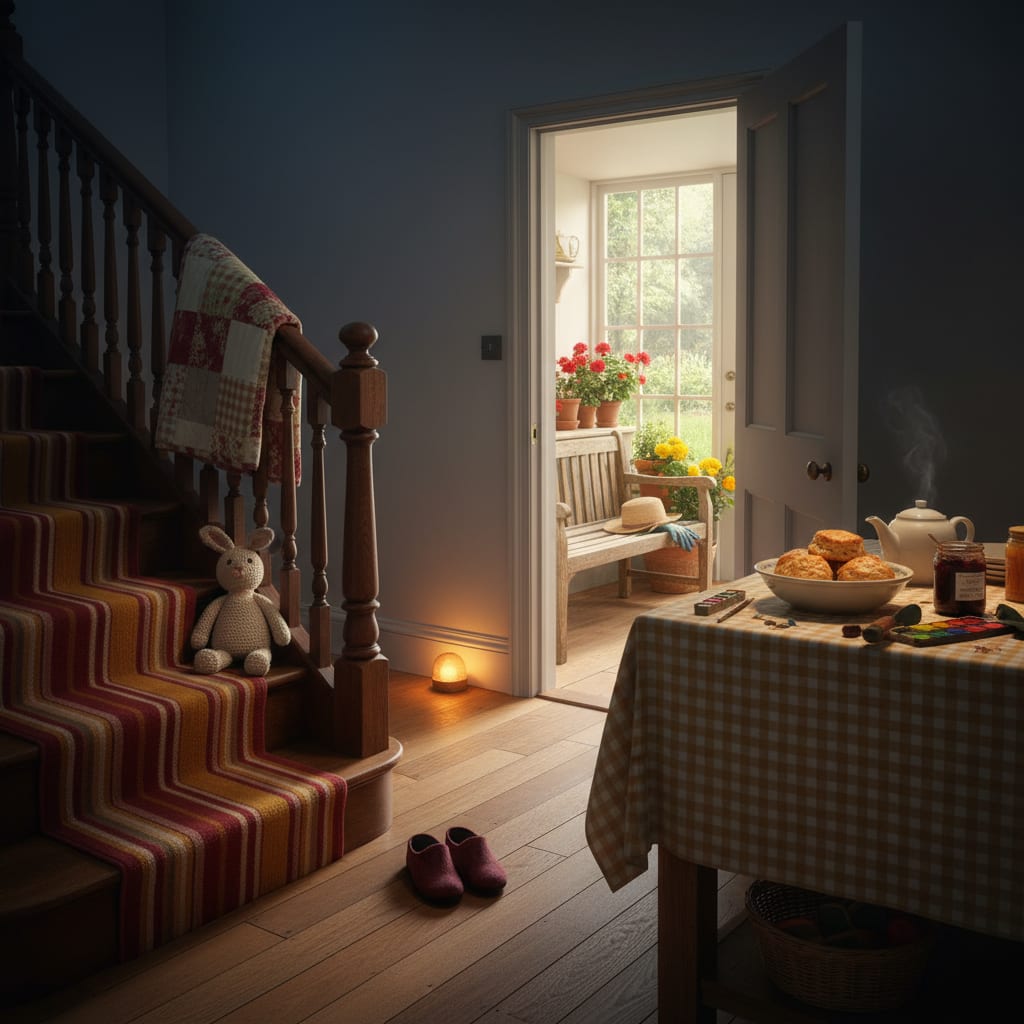
When a baby and their grandparents share a house, the most useful thing you can settle is who goes in at night — decided in daylight, before anyone has to decide it at 2 a.m. In almost every household the answer is the parents, with the grandmother staying put unless she’s asked. Everything else — thin walls, dinner at seven against bedtime at half past six, the doorbell at nap time — yields to small practical fixes. The relationship is what breaks, and it breaks in the dark, over crying you can hear perfectly from twenty feet away.
I don’t live with any of mine. Two of my daughters-in-law have done a stretch of it with their own mothers, and this comes from watching those years closely and asking nosy questions.
Decide who goes in, while it’s still daytime
You will hear the baby. That’s the whole difficulty. A visiting grandmother sleeps through it three towns away; a resident one lies there at 2:40 a.m. listening to a grandchild she could settle in four minutes, and the pull is physical.
Get up anyway and you cause three problems. You interrupt whatever the parents are working on, which may be deliberate and five nights old. You teach a baby that crying produces a rotating cast of adults, harder to settle for than one predictable one. And you hand the parents a grievance they’ll be too polite to raise for a fortnight.
So agree it in advance, out loud, in daylight:
- Nights belong to the parents, unless they ask.
- Agree how they’d ask. A text, a knock on your door, one named word through the wall. If there’s a signal, you never have to interpret silence at 3 a.m.
- Agree what you’d do unasked — a short list: illness, emergency, being called.
- Say once, early, that you’re happy to be woken. Then leave it — a repeated offer reads as pressure.
Daytime is different, especially if you’re doing childcare while they work — a separate negotiation I’ve set out in whose nap rules win. The short version: when the parents are home, they’re the parents.
Thin walls run in both directions
Living together makes noise everyone’s problem, and the conversation goes better if you raise your side of it first.
Their noise reaching you. Nobody warns grandparents that they’ll be awake for every waking too, for months, without the adrenaline that carries the parents through it. Earplugs are not a betrayal, and a fan on low in your own room is not sulking. A tired grandmother is the least useful person in the house.
Your noise reaching them. This is the one I’d ask you to audit honestly. The 6 a.m. kettle, the back door, the television through a shared wall, a phone call on speaker in the hall, the stairs that announce every step. Small fixes carry most of it: a runner on the landing, the kettle moved to the far counter, headphones for the evening show, and the doorbell chime switched off during naps so a delivery doesn’t undo forty minutes of work.
And the baby’s own noise-shield. White noise in the baby’s room does real work in a full house — it masks the front door, the older grandchild, the vacuum, you. Worth suggesting once if they haven’t tried it.
Dinner at seven meets bedtime at half past six
The collision nobody predicts is the evening. A household of adults eats late, watches something, has friends round on a Thursday — and a baby’s bedtime lands in the middle of it, immovable for a couple of years.
Something has to give, and it’s usually the adults — not because the baby outranks anyone but because the baby cannot be reasoned with and you can. Eat at six for a season, or eat late at eight once the baby’s down and make it pleasant. Clatter and cooking smells during the wind-down hour work against everything happening upstairs.
The other collision is the older grandchild thundering past a door that has just closed. That one isn’t solved by rules but by giving the three-year-old a job downstairs at exactly that moment.
Where the baby actually sleeps
In a shared house this gets crowded fast, because everyone has an opinion and one of them owns the spare room.
Current guidance is for babies to sleep in the parents’ room, on their own separate surface, for at least the first six months — often the easiest arrangement in a full house anyway, and the parents’ call rather than the household’s. After that, the question of moving them to a room of their own is genuinely open; Betteroo’s rundown of whether babies sleep better in their own room lays out both sides better than a strong opinion at the dinner table will.
What a grandmother can usefully offer is the thing she’s got that they haven’t: rooms. Put the baby on the wall shared with the fewest waking adults, and yourself on the noisy side. Offering up the quieter bedroom is worth more than any advice you’ll give all year.
Holding the line without starting a row
You live here. That changes the arithmetic completely — a visitor can absorb a disagreement and go home, and you can’t. So:
- One thing at a time, and not many of them. Safe sleep is a hill. Whether the sleep sack is the blue one is not.
- Never at 2 a.m., never in front of the child, never in front of your son’s friends. Tired people don’t concede, they entrench.
- Ask instead of announcing. “Do you want help, or company?” is the most useful sentence I know for a shared kitchen at midnight.
- Owning the house doesn’t come with the bedtime. If it’s your roof, that’s generous of you and it buys exactly no authority over their baby’s sleep.
- Book ten minutes on a Sunday. Not a summit — a standing check-in where each person names one thing working and one that isn’t. Small frictions compound when you can’t go home. My longer piece on grandparent boundaries covers the harder conversations.
Households that manage this treat the arrangement as something being designed rather than endured. The ones that struggle are terrifically polite, and nobody has mentioned the television through the wall since March.
The part that doesn’t flex
None of the above touches the safety layer, and living in makes that more important, not less, because you get so many more chances to be helpful in the wrong way.
On the back, every sleep, for the first year. A firm flat surface — crib, bassinet or play yard — with a fitted sheet and nothing else in it: no pillows, quilts, loose blankets, bumpers or positioners. Warmth comes from a sleep sack. Not an inclined sleeper, not a car seat left in the hall, and not asleep on your chest in the armchair at four in the morning — the specific risk of a grandmother who is up anyway and only meant to sit down for a minute.
Much of this changed after our own children were babies, and knowing why makes it far easier to hold at 4 a.m. than a rule you’re merely obeying — that’s the point of safe sleep rules for grandparents. Anything medical goes to the baby’s doctor, not to a household vote.

FAQ: sleep in a multigenerational house
Should I get up to the baby at night if I hear crying? Not unless asked, or in an emergency. Agree the signal in advance so you’re never guessing in the dark.
How do I raise the noise problem without sounding critical? Start with your own noise. Audit your kettle, your stairs and your television first, and the conversation about their 6 a.m. cartoons becomes a joint problem rather than an accusation.
The parents’ approach isn’t working. Can I say so? Once, briefly, in daylight, framed as an offer rather than a verdict — then let it go. In a shared house the cost of being right repeatedly outweighs the benefit of being right once.
What if the baby settles better for me than for the parents? Common, mostly because you’re calmer, not being the one up since five. Don’t say it out loud, and hand the baby back on hard nights especially.
Do the usual babysitting rules still apply if we live together? Yes, and they need saying more often, not less, because everything blurs when you share a fridge. The ground rules are in babysitting grandchildren.