❋ Grandkid Time ❋
Bedtime When Grandma Moves In Permanently
If you have moved in permanently, the first thing to settle about bedtime is whether you are in the routine or out of it — and then to be all the way in or all the way out, because half-in is the version that breaks. A bedtime routine is built for one adult and a child. Add a third grown-up who is always home and you haven’t added a helper; you’ve added a door the child can knock on. Agree the shape once, in daylight, and hold it six weeks before anyone reviews it.
I don’t live with any of my five. Two of my closest friends do — one after her husband died, one after the mortgage stopped making sense — and this comes from three years of phone calls in which bedtime came up more than any other word. You’re in ordinary company: Pew Research counted 59.7 million Americans in multigenerational family households in March 2021, four times the 1971 figure.
This is not a visit, and that reverses the advice
A help visit with an end date runs on one rule: build nothing that stops working the day you drive home. A permanent move is the reverse. You should install. This house has to run on an ordinary Tuesday four years from now, and a routine that treats you as a temporary irregularity will quietly fail. The commonest mistake I hear is a grandmother eleven months in, still behaving like a guest at seven — hovering in the hall, apologising for the landing light. You’re a resident, and residents get a job.
The wider household logistics — thin walls, the dinner hour, 2 a.m. — are in baby sleep in a multigenerational home. This piece is only bath to lights out.
In the routine or out of it
There are three workable shapes, and no fourth.
You do bedtime. Some nights, by agreement — the whole sequence, exactly as the parents run it. Same order, same words, same songs, same number of stories. Not your version. Theirs, copied.
You do none of it. Goodnight downstairs before it starts, then you’re unavailable — reading, out, in your own room. An honourable choice, and right in plenty of houses.
You do a named piece. The bath, or teeth — one job with edges, handed over at the door.
What fails is the fourth thing nobody chooses on purpose: floating. Semi-involved, sometimes doing the story and sometimes not, appearing at the top of the stairs at 7:40 because it had gone quiet. The child can’t predict you, and unpredictability is what a bedtime routine exists to remove. The AAP’s toddler bedtime advice rests on the same point — same time every night, same quiet sequence — because “this helps your child know what to expect.” Put whichever shape you pick on the calendar as an arrangement rather than a mood.
The extra door
This only happens in a three-adult house, and it is the biggest single reason bedtime gets longer after a grandmother moves in.
A child in a two-adult house who wants to delay bedtime has one adult to work on and one backstop. In a three-adult house she has a court of appeal — one more person downstairs who hasn’t said no, is delighted to see her, and has no idea what was agreed upstairs. She works that out fast.
The AAP puts the mechanism bluntly: children’s “main goal is to get you to appear. So if you appear for any reason, even just for ‘checking,’ they will expect you to come each time they call out.” A resident grandmother is a second person available to appear.
So, the rules I’d hold hardest:
- One goodnight. Downstairs, before the routine starts, warm and unhurried. Not a second one at the bedroom door.
- Never overturn a no you didn’t hear. She appears asking for water; the answer is “Daddy’s doing bedtime,” and you walk her back to the stairs.
- Don’t be the one who goes in. Even for a good reason. Especially for a good reason.
- Don’t hover on the landing. A grandmother’s floorboard is an invitation.
If bedtime has already stretched into an hour of small requests, Betteroo’s guide to why a toddler keeps getting out of bed covers the rest, and its toddler bedtime routine is worth all three of you reading, so you argue from the same page rather than from memory.
Take the hour before, not the half hour itself
If you want to be genuinely useful — and most grandmothers who move in are desperate to be — the valuable hour isn’t bedtime. It’s the one before it. Five to six-thirty is when a household with small children comes apart, with two parents who got in forty minutes ago.
Take that hour. Cook it, serve it, clear it, do the bath, hand over a clean child at the bedroom door. The parents then start bedtime with something left in the tank, which does more for that child’s sleep than anything you could do inside the room — and it ends, so you’re not permanently on call in your own home.
Where you go at seven o’clock
Nobody warns a grandmother about this, and it’s why I wanted to write the post.
Most permanent moves are caused by something — a death, a fall, a house that had to be sold. You arrive with the loss still fresh, into a home that is warm and full and not yours, and every evening at seven the household folds itself upstairs while you sit downstairs listening to a bedtime story you can hear but aren’t in.
That hour is where resentment gets made — not in a row, but in forty minutes a night, five nights a week, for a year. So build your own evening deliberately:
- Have somewhere to be. A standing Tuesday — a class, a choir, a shift, a walk that happens whether or not anyone needs you. The cure for hovering is somewhere else to be.
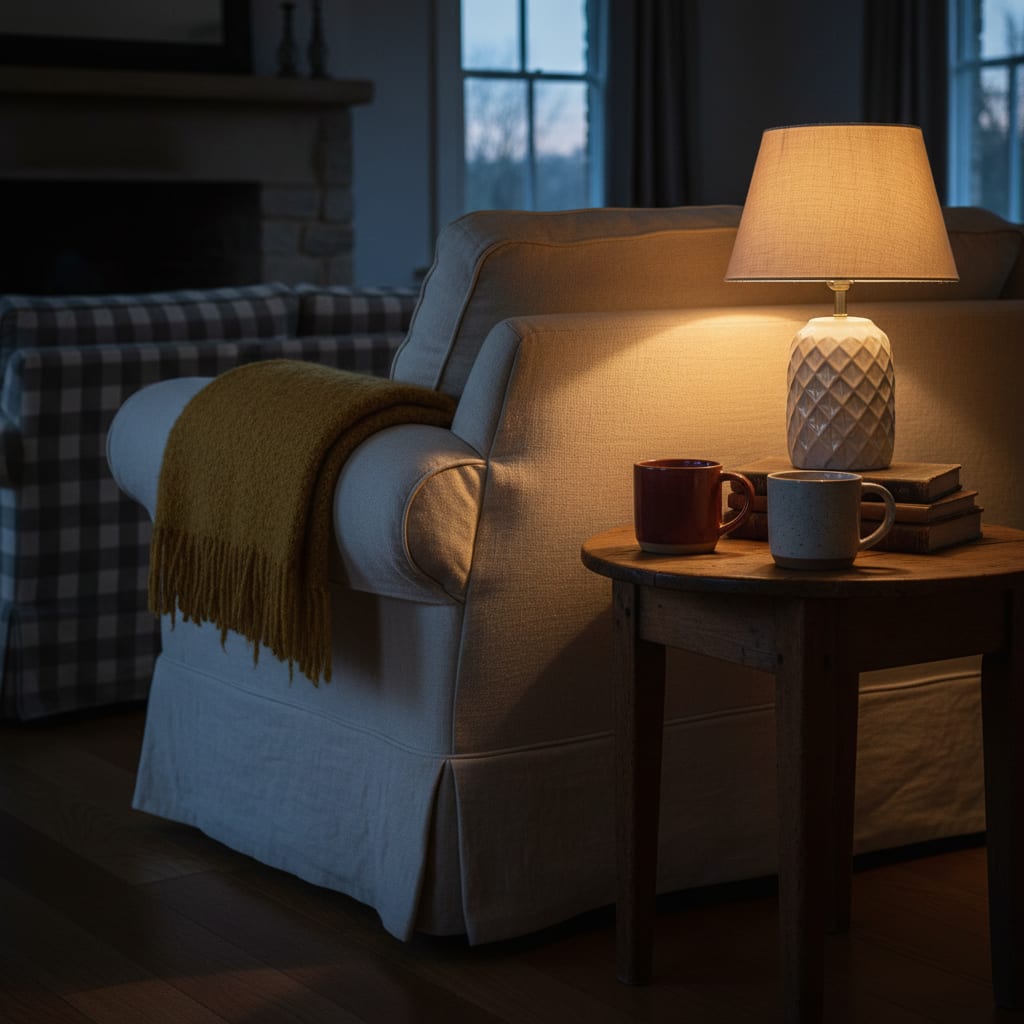
- Make your room a room, not a bedroom. A chair, a lamp, a kettle. Somewhere you go to.
- Take one bedtime a week, by arrangement. Friday is yours. Then the other six aren’t, and you’re off duty rather than excluded.
- Say the lonely bit out loud, once, in daylight. My friend told her son, “Seven to eight is the hardest hour of my day,” and he started coming down at eight with two cups of tea. That was the whole fix.
Expect a hard first fortnight: children test a new permanent adult, and bedtime is where they do it. Hold the agreed shape and review it on a Sunday afternoon, never at 7:45 on the landing. The harder conversations, about authority rather than schedule, are in grandparent boundaries.
The floor that doesn’t move
If there’s a baby in the house too, the safety layer isn’t up for household discussion, and living in gives you many more chances to be helpful in the wrong way.
On the back, every sleep, for the first year, on a surface NICHD’s Safe to Sleep guidance describes exactly: firm, flat “like a table, not a hammock,” level “not at an angle or incline,” covered only with a fitted sheet, nothing soft in there. Warmth comes from a sleep sack. And the specific risk for a grandmother who is up anyway and only meant to sit down for a minute — couches and armchairs “are particularly dangerous when an adult falls asleep on them while feeding or comforting baby.”
Knowing why those changed since our own children were babies makes them easier to hold at four in the morning — that is what safe sleep rules for grandparents is for.

Questions grandparents ask about moving in
Should I do bedtime if I live with my grandchildren?
Only if the parents ask, and then do it their way. The worst option is part of it on some nights and not others.
Why did bedtime get harder after I moved in?
There’s a third adult to appeal to now. Hold one goodnight, downstairs, and never overturn an answer you didn’t hear given.
Is it wrong to want an hour to myself in the evening?
No — it’s necessary. Seven to eight is the loneliest part of a live-in grandmother’s day, and the households that manage best give her somewhere to be.
What’s the most useful thing I can take on?
The hour before bedtime — dinner, clearing up, the bath — handing over a clean child at the door.