❋ Grandkid Time ❋
Grandparents Day Crafts Little Hands Can Make
The best Grandparents Day crafts are the ones a child can genuinely make without an adult quietly redoing it: handprint art, salt-dough keepsakes, a painted pot with something growing in it, a drawn portrait left exactly as drawn, and a dictated interview book. I taught second grade for thirty-one years and have now supervised five grandchildren through this holiday, so I know precisely which projects survive contact with a three-year-old and which end in tears at step four. Here are the survivors, sorted by age, in time for Sunday, September 13, 2026.
The teacher’s rule: their hands, their mess, their gift
Before the project list, the single principle that makes all of these work. A craft is a gift only if the grandparent can see the child in it. Wobbly lines, a thumbprint of paint in the wrong place, a name written backwards — those are the features, not the defects. Every time an adult “helps” a Grandparents Day craft into neatness, the value drops. I have received both kinds. I know.
So: set up somewhere you don’t mind ruining, put an old shirt on the child, and then sit on your hands.
Ages 1–3: handprints and pressed things
Toddlers can’t follow steps, but they can be pressed into paint, which is the entire genre.
- Handprint flowers. One painted handprint as the bloom, a green stem drawn underneath. Two hands from two siblings on one page makes a bouquet.
- Handprint hearts. Two hands angled to meet at the wrist. Fiddly for you, effortless for them.
- Footprint anything. Feet are less cooperative than hands, but a footprint from a one-year-old will destroy a grandmother in the best way.
- A pressed-leaf card. September walk, collect leaves, press them flat under a book overnight, glue to folded card stock. This is the toddler project with the highest ratio of dignity to effort.
Practical note: use washable tempera paint, roll it on with a foam brush rather than dipping the hand into a pot, and have a wet towel already in your hand before you start. Ask me how I know.
Ages 3–5: salt dough and clay keepsakes
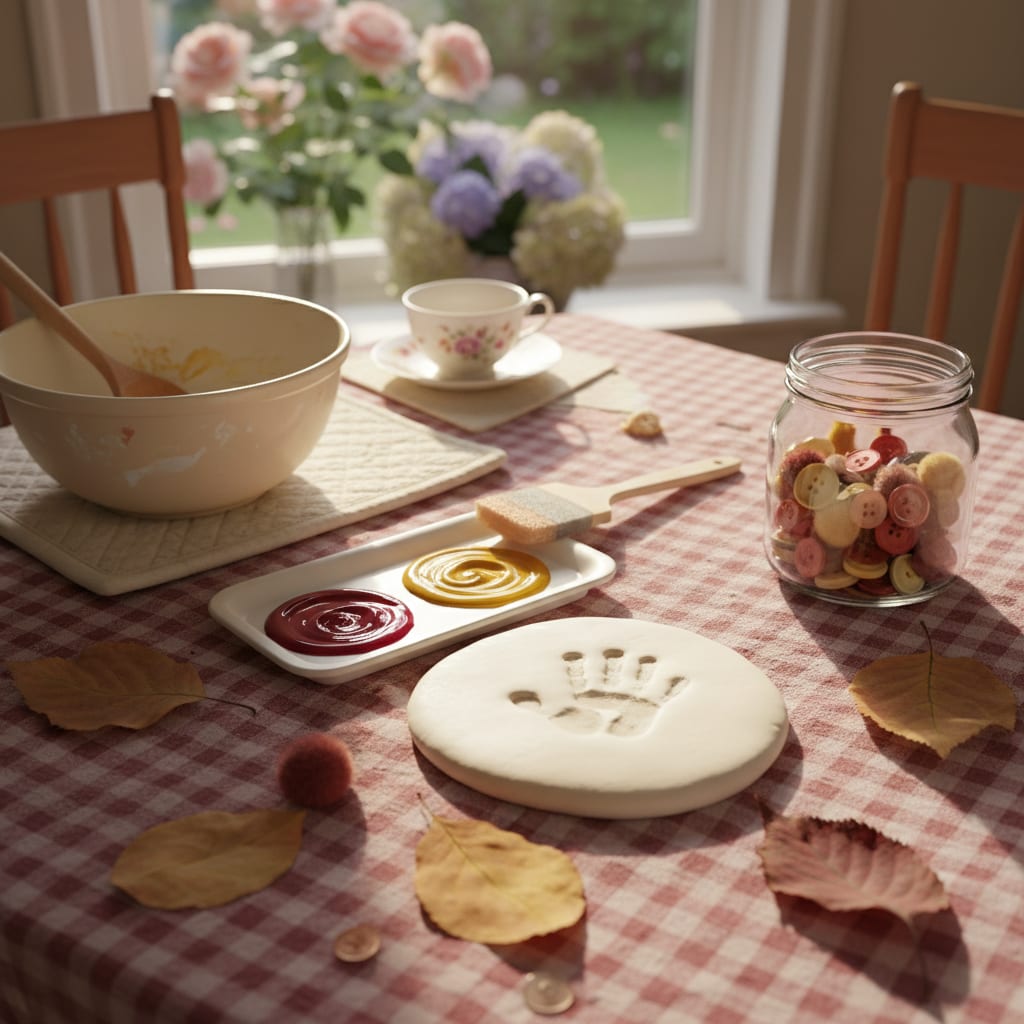
This is the sweet spot age, and the sweet spot project is the pressed handprint keepsake.
Salt dough, the recipe every teacher knows: roughly two parts flour to one part salt to one part water, mixed until it holds together like play dough. Roll it out to about a half inch, cut a circle with the rim of a glass, press the child’s hand in firmly once — once — and poke a hole at the top with a straw for ribbon. Bake low and slow, somewhere around 200°F for a couple of hours until hard, then let it cool completely before painting. Seal with a clear craft sealer if you want it to last, and it will last decades.
If you’d rather skip the oven, air-dry clay does the same job with less supervision. A bucket of Crayola Air-Dry Clay is the classroom standard for good reason — it’s forgiving, it takes a handprint cleanly, and it paints well once it’s fully dry. Give it several days before painting, not several hours; impatience is how you get a cracked keepsake and a heartbroken four-year-old.
Other projects in this band:
- Painted flower pots with a bulb or seedling planted inside. Mid-September is fall-planting season, so this one is still alive at Christmas.
- Beaded bracelets with big pony beads. Pipe cleaner instead of string — a four-year-old can thread a pipe cleaner and cannot thread string, and that difference is the whole project.
- Decorated picture frames. Cheap wooden frame, buttons, pom-poms, glue. Put a photo of the child and grandparent in it before wrapping.
Ages 5–6: portraits, books and letters
Once a child can hold a pencil with intent, the crafts get to carry words.
- The unassisted portrait. Hand them paper and ask them to draw Grandma or Grandpa. No corrections. Frame it as drawn. Mine gave me purple hair and eleven fingers.
- The interview book. Fold three sheets of paper into a booklet. You ask the questions, they answer, you write the answers verbatim on each page and they illustrate. How old is Grandma? What is her job? What does she love? Verbatim is the entire art form — “Grandma’s job is snacks” is not a thing you’d ever have written yourself.
- A dictated letter. Same principle, one page. The child talks, you transcribe without editing, they sign it.
- A coupon book. Hand-drawn coupons for one hug, one weeding session, one dish-dryer. Grandparents redeem these with alarming enthusiasm.
- A recipe card in their handwriting. The child copies out grandma’s cookie recipe, misspellings intact, on a card she can actually keep in the box.
Crafts that travel well in the mail
For long-distance grandparents, everything above needs to survive a padded envelope. Flat wins: portraits, pressed leaves, the interview book, the letter, the coupon book. Salt dough travels if it’s fully cured and wrapped generously in bubble wrap, though I’d send it in a small box rather than an envelope. Painted pots do not travel; make those for grandparents you’ll hand them to.
Photograph the child making it and send the photo too — half the pleasure of a grandkid craft is picturing the making of it.
Setting up so you enjoy it too
A retired teacher’s staging advice, which applies equally to a grandmother’s kitchen: put everything the project needs on the table before the child arrives, and nothing it doesn’t. Cover the surface. One project at a time. Expect the whole thing to take about a third as long as you planned, because it will, and have a backup activity ready — my rainy day activities with grandkids list exists precisely for the twenty minutes after a craft ends and before anyone’s parents arrive.
And if the crafting is happening at the grandparents’ house rather than for them, all of this doubles as a lovely way to spend the day itself. More of those in Grandparents Day ideas the whole family will love.
When to start making them
Salt dough and air-dry clay need drying time, so start the weekend before at the latest — that’s the weekend of September 5–6 for a September 13 celebration. Paper crafts can happen the morning of. If you’re unsure of the date or need next year’s, I’ve laid out the calendar in when is Grandparents Day 2026. And if the craft is meant to sit alongside something purchased, the pairings that work are in Grandparents Day gifts worth more than a card.
FAQ: Grandparents Day crafts
What crafts can a toddler make for Grandparents Day?
Handprint and footprint art, pressed-leaf cards, and painted paper. Anything requiring more than one step or any waiting is beyond a toddler — lean on the parts of the project where the child’s body is the tool.
What is the easiest Grandparents Day craft?
A handprint flower: one painted palm pressed onto paper, a stem drawn underneath, the child’s name and the year written at the bottom. Five minutes, one sheet of paper, and it’s a keepsake for thirty years.
How do you make a salt dough handprint keepsake?
Mix roughly two parts flour, one part salt and one part water into a dough, roll it about half an inch thick, cut a circle, press the hand in once, and make a hole for ribbon. Bake low — around 200°F — for a couple of hours until hard, cool completely, then paint and seal.
What can grandkids make for grandparents who live far away?
Flat, mailable things: a drawn portrait, a dictated letter, a stapled interview book, pressed leaves, or a coupon book. Send a photo of the child making it along with the finished craft.
Should adults help with Grandparents Day crafts?
Only with setup, safety and transcription. Do not straighten the lines, fix the spelling or redo the painting — the imperfections are the reason grandparents keep these things for decades.