❋ Grandkid Time ❋
Halloween With Grandkids: Low-Stress Grandma Ideas
Pick one job and do it well. Halloween goes wrong for grandmothers when we try to be the costume department, the walking escort, the porch host and the sugar police in one evening. Choose a single role — the short trick-or-treat loop, or the porch with the bowl — and let somebody else own the rest. Then aim the night at one outcome: a child who comes home tired rather than wrecked. Everything below follows the order the evening happens.
I have done Halloween with grandchildren aged one, two, three and five. The only bad year was the one where I tried to do all of it.
Choose the walk or the porch, not both
These are two different evenings and they need two different grandmothers.
The walk means the cold, at the child’s pace — roughly four houses and then a demand to be carried. Take it if you want the photographs and don’t mind the carrying. The porch means a chair, a bowl, a blanket and a clear view of every costume in the neighbourhood — the better job if your knees have opinions, or if there is a baby at home who needs somebody with her.
Say which you want before the day. The default assumption is that grandma takes whatever is left over — which is how you end up walking a mile in the dark holding a pumpkin bucket and somebody’s shed jacket.
Costumes a toddler will actually keep on
The costume is decided days before Halloween, in your kitchen, and the only real question is whether the child can move in it.
The American Academy of Pediatrics’ Halloween safety guidance is unglamorous and exactly right: costumes and shoes should fit, costumes should be short enough to prevent tripping and not catch on things, hats should not slide over the eyes, and sharp or long accessories — swords, canes, sticks — are a hazard if a child stumbles. It suggests non-toxic makeup as a safer alternative to a mask, tested first on a small patch of skin, and asks you to look for “flame resistant” on the costume label and in wigs and accessories.
Masks are where small children break. A two-year-old wears one for about ninety seconds, and the ninety-first is a scream in a stranger’s driveway. Paint the face instead — something washable like Crayola’s face and body paint crayons goes on in thirty seconds, comes off in the bath, and cannot be torn off in a temper halfway down the street. Patch-test the night before.
Two more things learned the hard way. Put the warm layer under the costume, or it vanishes beneath a coat and the child is furious in every photograph. And make the whole thing bright: the AAP recommends a colourful treat bag plus reflective tape or glow-in-the-dark elements, because drivers genuinely cannot see a small child in a dark cape.
The short loop for under-fives
A three-year-old does not want two hours of trick-or-treating. She wants twenty minutes, then the bag emptied on a floor somewhere warm.
Plan a loop that starts and ends at the same front door: eight to twelve houses, one side of one street, back where you began. Go out and back in a straight line instead and the second half becomes a march away from home — and the second half is always where somebody wants to be carried.
Say the AAP’s street rules out loud to an older grandchild before you set off: cross as a group at a crosswalk rather than mid-block, never step out from between parked cars, stay on well-lit streets and the sidewalk, use a flashlight after dark, and only approach homes with the porch light on. It also notes that child pedestrian injuries are more likely on Halloween than on any other night of the year — and that where trick-or-treating starts after dark, an earlier daytime event run by the town or park district may suit a small child better.
Porch duty, done properly
If you take the porch, take it seriously, because it is the job with the most to give.
Clear the path first. The same AAP page asks you to remove tripping hazards from porch and yard — hoses, toys, bikes — sweep wet leaves off the steps, replace burned-out outdoor bulbs, and restrain the dog so she doesn’t jump at a child in a costume. That last one matters; a friendly labrador is a monster to a three-year-old dressed as a dinosaur. If yours isn’t usually a small-child house, this is the same room-by-room pass as toddler-proofing grandma’s house, aimed outdoors.
Then sit down and let the grandchildren take turns holding the bowl. Handing the sweets out is the job small children like best and nobody ever offers them.
Pumpkins without the knife
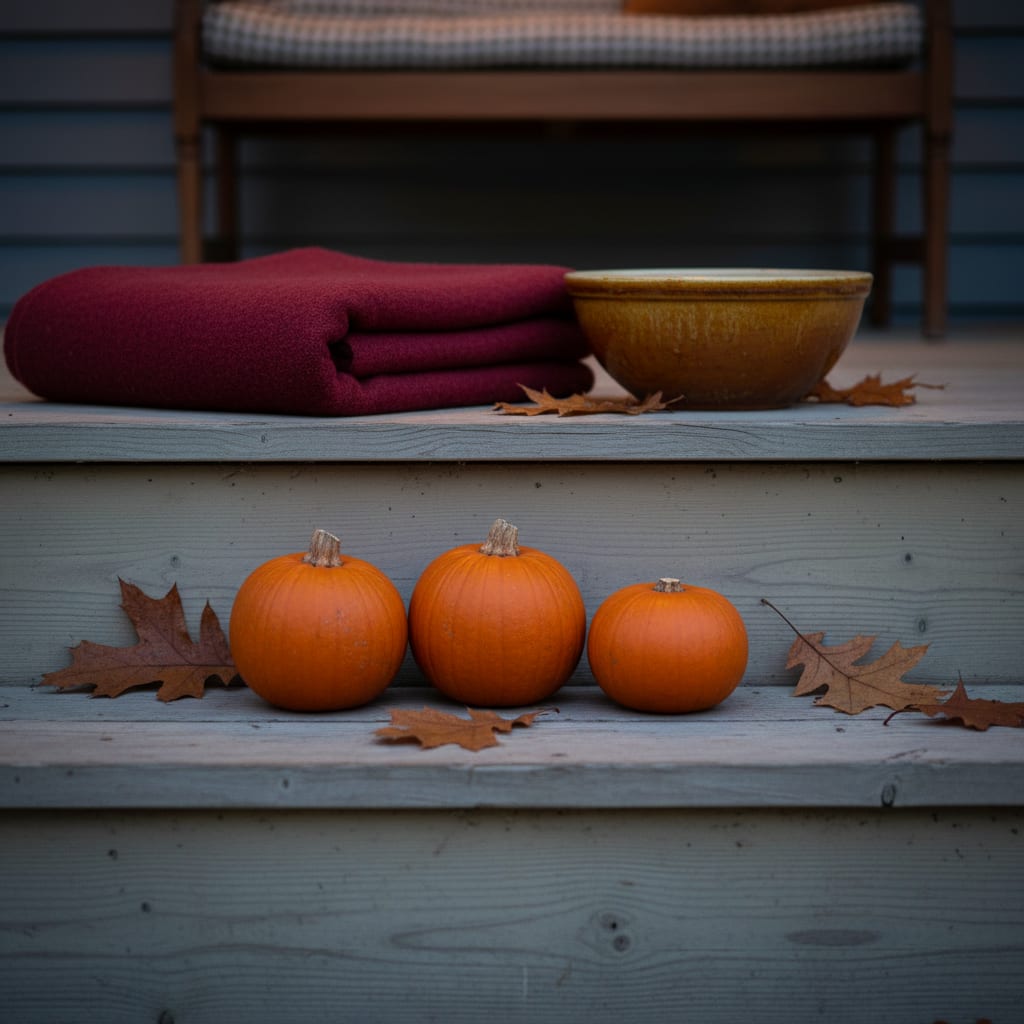
Carving is an adult job. The AAP is direct about it: small children decorate rather than carve — a face drawn on with markers is a perfectly good pumpkin — the cutting stays with an adult, and little ones help by pulling out the pulp and seeds.
Light it with a battery-operated flameless candle, a flashlight or a glow stick. If you use a real candle, a votive is safest, and the lit pumpkin never goes on a porch step or anywhere a costume can brush past it.
Pumpkin guts on newspaper at the kitchen table is a genuinely good afternoon for a three-year-old — the same shape as the handprint work in our Grandparents Day crafts: messy, short, finished in one sitting, and it slots straight into the indoor rainy-day list if the weather turns.
Sweets are the parents’ call, not yours
Ask once, in October: how much is she allowed tonight, and who holds the bag afterwards?
Then do exactly what they said. Halloween is the easiest night of the year to be the grandmother who “just let her have a few more,” and it is the night the parents are already braced for a bad bedtime. Being the reliable one costs nothing and buys the next invitation. If you want to send something extra home, send the thing that isn’t food — the AAP suggests non-edible goodies for trick-or-treaters anyway, and a glow bracelet beats a fun-size chocolate bar at that age.
Handing them back sleepable
The evening’s real deadline is bedtime, not the last house.
Work backwards. If bedtime is seven, you are home at half past six, leaving the loop while everybody is still enjoying it rather than when the wheels come off. A child who stops one house early goes to bed talking about Halloween; a child who stops one house late goes to bed screaming about it.
Keep the ending boring on purpose: bath, pyjamas, the usual books, the usual song, the usual order. The costume comes off before the bath and goes out of sight, because a cape over a chair in a dark bedroom is a second conversation at half past eight. If the child sleeps at your house afterwards, the routine she knows beats any amount of excitement — the same principle as an ordinary sleepover at grandma’s: change the night, never the order of operations.
FAQ: Halloween with grandkids
What can I do with a one-year-old on Halloween?
Stay in and let her watch. A one-year-old has no use for trick-or-treating, but will happily sit on a knee and look at the costumes coming up the path. Dress her in something soft with no hood and no mask, photograph her early while she is cheerful, and keep bedtime where it normally is.
How long should trick-or-treating be for a toddler?
Twenty minutes to half an hour is plenty — eight to twelve houses at toddler pace. Plan a loop that finishes back at the door you started from, so the end of the walk is not a long trudge home.
Should I let my grandchild wear a mask?
Under about four, face paint is the easier choice — the AAP suggests non-toxic makeup as a safer alternative to masks, and small children pull masks off anyway. If an older grandchild is set on one, check it doesn’t slide over the eyes or block their vision.
What if the weather is awful?
Have the indoor version ready and announce it cheerfully rather than apologetically: pumpkin decorating at the table, costumes worn indoors for the photographs. Small children mind far less than adults do, provided nobody treats it as a disappointment.