❋ Grandkid Time ❋
Why the Routine Works at Daycare and Not at Grandma's
If your grandchild naps beautifully for a daycare teacher or a sitter and then fights you for ninety minutes, nothing is wrong with the child and nothing is wrong with the routine. Daycare has three things a grandmother’s house usually doesn’t: an unmoving clock, an unchanging room, and an adult with no emotional stake in whether the nap happens. I have all the love and none of the structure. Once I understood that, the fix stopped being “try harder” and became “copy the parts I can.”
Five grandchildren have been through this house, three of them in paid care at the same time. The gap is real, it is not a comment on you, and most of it is fixable.
What daycare has that grandma’s house doesn’t
Four things, and each one points at a different repair.
A clock that doesn’t negotiate. The room goes down at 12:30. Not when the puzzle’s finished, not when the child seems tired — 12:30. My house runs on “we were having such a nice time,” which is how a nap starts forty minutes late and then doesn’t start at all.
A room that is identical every day. Same cot on the same patch of floor, same gray light, same smell of crackers. Sameness is most of what makes a nap easy. My spare room is a novelty twice a week, and novelty is the enemy of sleep.
No audience worth appealing to. At daycare, eight other children lie down; there is nothing better on offer. At my house there is one adult, she is a soft touch, and the child knows it by about fourteen months.
A caregiver with seven other children. A teacher physically cannot pick a child up at the first grumble. I can, and I want to — and that difference alone changes what the child expects next time.
Where I’m the reason it collapses
This is the part nobody says out loud, so I’ll say it about myself.
I schedule the good bit across the nap. The park, the visitor, the cousin at eleven — I want the day to be worth something, so I stack it, and hand back a child too far past tired to settle. An overtired toddler doesn’t look sleepy; she looks like she found the coffee.
I start the routine late because I can’t bear to end the fun, then run it fast to catch up — which the child reads as an entirely different routine.
I go in at the first noise. Not the crying, the noise: twenty seconds of grizzling that would have turned into sleep, and I’ve opened the door and reset the whole thing.
I like the contact nap and I’ve been known to engineer one. A grandmother’s arm is a persuasive mattress, and a nap taken on somebody’s chest is a perfectly ordinary thing for a baby to want. But if the parents have spent three months getting naps into the crib, an afternoon on Franma isn’t a treat, it’s a withdrawal from someone else’s account.
And I keep “my version” of things nobody asked me to change — the extra story, the lights left on a bit, the little song at the door. Each is small. Together they’re a different routine wearing the same name.
Copy the clock, not the classroom
You cannot reproduce daycare and shouldn’t try. What you can copy is the boring skeleton.
- Get the times, not the vibe. Ask for nap start, expected length, the latest it may run, and bedtime. Write them on the fridge. If you have one schedule both houses can work from, better still — my daughter shares hers with me, and it ended the “does he look tired to you?” conversation for good.
- Get the sequence in order. Diaper, sleep sack, curtains, two books, song, down — same order, same words, even if it feels stilted coming out of your mouth. Small children run on liturgy.
- Front-load the day. Outing in the morning, quiet lunch, nap. The exciting thing goes before the nap or after it, never across it.
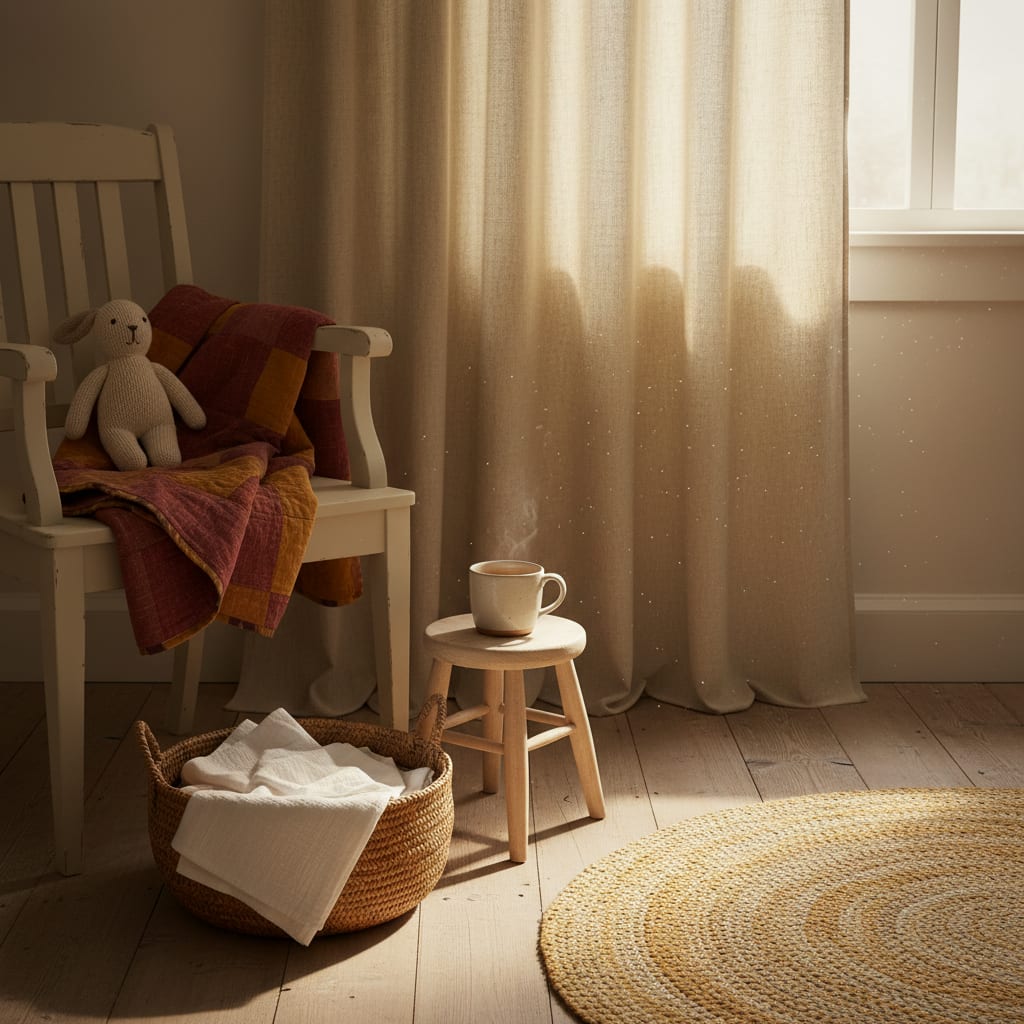
- Keep the room the same every time. Same crib in the same corner, dark, dull, a little white noise. Don’t move it because the light’s nicer in the back bedroom.
- Start the wind-down ten minutes early. Daycare’s real advantage is that the transition begins before anyone is desperate.
The first grumble is the whole ballgame
Decide before you start what you’ll do when she fusses, and say it out loud. Mine: five minutes by the kitchen clock before I go near that door, and when I do go in I don’t lift her out — a hand on her back, and out again.
Whatever the parents do, do that. If they wait, wait. If they go in at two minutes, so do you. The child isn’t testing your love; she’s learning what happens at your house, and she’ll have it worked out by the second visit either way.
Safe sleep doesn’t bend for either house
The structure is negotiable. This isn’t, and it’s where improvising does real harm.
Every sleep is on the back, on a surface that is firm, flat and level, covered only with a fitted sheet — crib, bassinet or play yard, nothing tilted, nothing soft. If she drops off in the car seat, stroller or swing on the way home, the AAP says to move her to a firm, non-inclined surface as soon as you can. And the one that catches grandmothers: never doze off on a sofa or armchair holding the baby. Both the NICHD and the AAP name couches and armchairs as particularly dangerous precisely because the adult falls asleep there. An afternoon with a baby on your chest is lovely right up until you close your eyes too.
Much of this changed after we raised our own; the full list is in safe sleep rules for grandparents.

When it genuinely isn’t you
Sometimes you did everything right and the nap died anyway. A first visit to a new room means a short nap almost by definition. A teething child, one coming down with something, or one in the middle of a sleep upheaval naps badly for everyone including the teacher. A baby who has just dropped a nap is a mess for a couple of weeks wherever she is.
The tell is the pattern, not the day. If she naps for you on most visits and one Tuesday is a write-off, that’s weather. If she has never once napped for you, it’ll be one of the four things above, and usually the clock.
When a day does go wrong, bring bedtime forward rather than clawing the sleep back with a five o’clock nap, and tell the parents plainly. Whose rules apply to which parts of the day is a longer conversation, in whose nap rules win; the room-and-crib setup lives in baby sleep at grandma’s house.
FAQ: naps at daycare versus naps at grandma’s
Why does my grandchild nap for daycare and not for me? Usually timing and sameness rather than anything about you: daycare naps at a fixed hour in an unchanging room, and grandma’s nap starts late in a room the child sees twice a week. The second cause is that you’ll answer a grumble and a teacher with seven children can’t.
Should I try to make my house exactly like daycare? No. Copy the clock, the sequence and the room’s sameness. Don’t chase the ratio, the peer group or the institutional flatness — you can’t have them, and the relationship is the reason the child likes coming.
Is it bad if she only naps on me? It’s normal for babies to sleep well on a person, and it isn’t dangerous while you’re awake and upright. It becomes a problem two ways: it can undo crib naps the parents are working on, and there’s the risk of you falling asleep on a sofa or armchair with her. Ask the parents before you make it your habit.
She naps fine for the nanny at her own house. Why not at mine? Because at her own house nothing else has changed. A nanny runs a familiar room, a familiar crib and the usual hour; you’re running an unfamiliar room and, often, an unfamiliar hour. Fix the hour first — cheapest change, usually the whole problem — and give it three or four visits at the same time of day before you conclude anything.