❋ Grandkid Time ❋
15 Video Call Activities Grandkids Won't Wander Off From
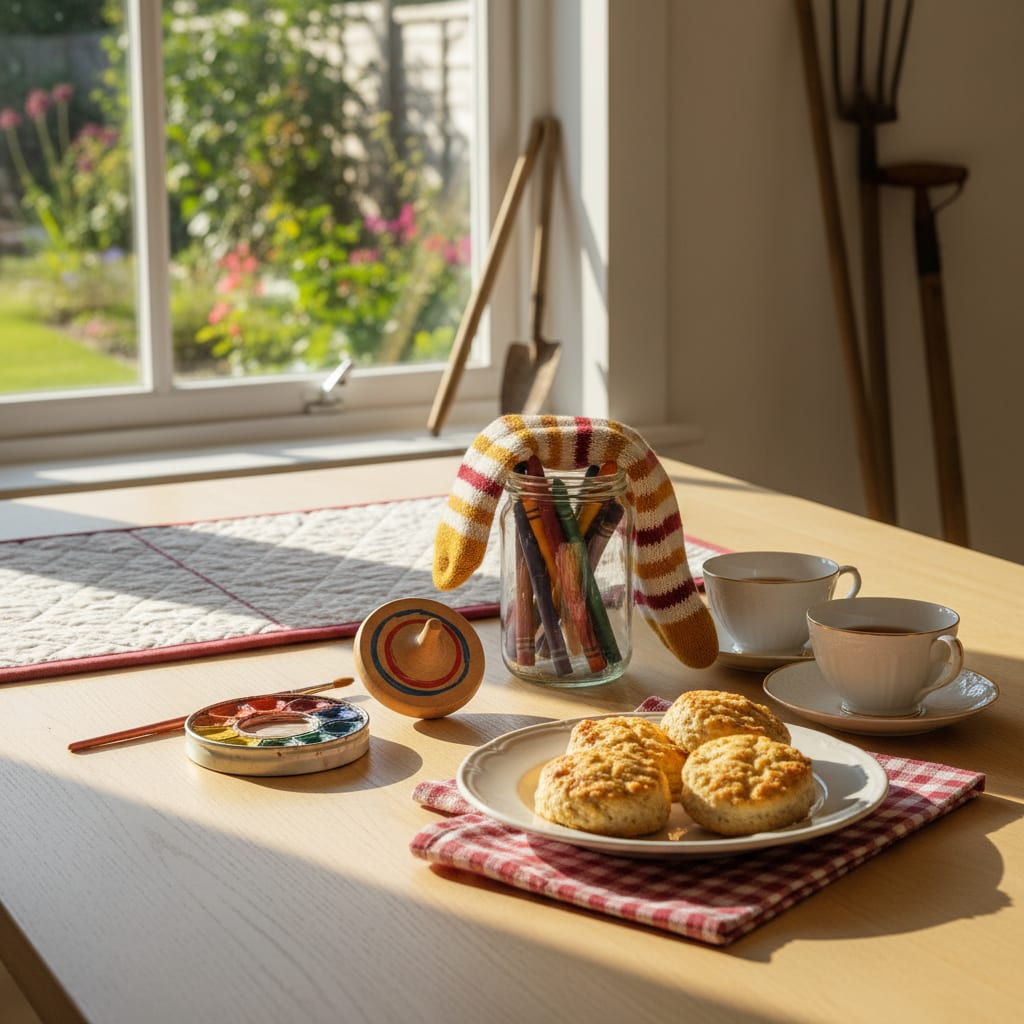
The reason your video calls with a small grandchild keep collapsing is that you’re trying to have a conversation. Under about six, children can’t do a talking call — they can only do a doing call. Swap “how was your day?” for a shared activity with a start, a middle and an end, and the same child who lasted ninety seconds last week will stay for twelve minutes. Below are fifteen that have worked on my own five, sorted by age, along with the setup details that quietly decide whether any of it lands.
Set up so the activity can happen
Five minutes of preparation is worth more than any amount of enthusiasm.
- Prop your phone or tablet up and step back. Nobody wants a nostril. A stand or a leaning stack of books gets your hands free and your whole upper half in frame, which is what makes puppets and objects possible.
- Light your face, not your window. Sit facing a window rather than in front of one, or you’ll be a silhouette.
- Have your props already out. The moment you leave frame to hunt for something, you have lost the child.
- Ask the parents for the good half-hour. Fed, rested, not about to go out. Hungry or tired children cannot do this and it isn’t their fault.
- Let them hang up. Ending on their terms, mid-fun, is what makes them want the next one.
Babies (0–1): you’re doing this for later
A baby will not do an activity. What you’re building is familiarity with your face and voice, so that at eleven months, recognition arrives.
1. Peekaboo with a real cloth. Slow, exaggerated, same rhythm each time. It’s the reliable one — anticipation and a silly face are close to the only jokes a baby has, and roughly when that first proper belly laugh shows up is covered nicely in Betteroo’s guide to when babies start giggling.
2. Sing the same song every call. One song, forever. Same one at ten months and at four years. It becomes your signature tune and it’s the thing they’ll hum when they miss you.
3. Be background noise. Ask the parents to prop you on the counter while the baby has breakfast. You aren’t performing; you’re being the voice in the room. This is far more effective than it sounds.
Toddlers (1–3): short, physical, repetitive
4. Grandma says. Simon Says with no losing. “Grandma says touch something blue.” They run, they come back, they’re delighted with themselves.
5. Show me your… “Show me your shoes. Show me your dinosaur. Show me the fridge.” A toddler will happily give you a two-minute tour of a cupboard.
6. The puppet who can’t get things right. A sock puppet who calls the dog a cat and the banana a telephone. Being corrected by an adult-shaped thing is the funniest experience available to a two-year-old.
7. Snack together. You both have a biscuit and a cup. It’s a tea party, it lasts as long as the biscuit, and it’s oddly companionable.
8. Hide and seek with the camera. They hide, the parent carries the phone, you count. Works even when nothing else does.
Preschoolers (3–5): the golden window
9. The same activity pad on both ends. This is the trick that changed my Sundays: buy two identical mess-free colouring pads, keep one, post the other. We open to the same page and colour the same picture together. A pack of Water Wow reusable water-reveal pads is what we use — water pen, no mess at their end, and it resets when it dries, so the same three pads have lasted two years.
10. Scavenger hunt. “Find something round. Something that smells nice. Something older than you.” Five items, sixty seconds each, and they end the call having run around the entire house.
11. Cook the same thing. Not a real recipe — mix a mug cake, or ice two biscuits, side by side. Half the kitchen entries in my list of things to do with grandkids work at nine hundred miles, only with less of my floor to sweep.
12. Drawing tag. You draw a circle and hold it up. They turn it into something. Then they draw a squiggle for you, and you turn it into something worse. Endlessly renewable.
13. Guess my object. Hold something just out of frame, describe it badly, let them guess. Then swap.
Fives and sixes: they can finally do a “real” call
14. Read a chapter, stop on a cliffhanger. At this age you can genuinely serialise a book across weeks, and the details of doing it well — camera angle, which books work, how to hold up the pictures — are in how to read to grandkids over video.
15. Teach them something small. A card game, a knot, a magic trick, a couple of words in another language, how to whistle. Being taught by a grandparent is a completely different feeling to being taught by a parent, and it’s the beginning of the relationship you’ll have with them at fifteen.
What to do when it flops anyway
Sometimes the child walks off after four minutes. That is not a verdict. Say “off you go, see you Sunday!” cheerfully, and spend the remaining two minutes talking to their mother — that conversation is what keeps the calls happening at all.
Keep a short list of what worked and roughly which week, because favourites rotate fast at this age. And don’t try to make every call brilliant; the point of the weekly slot isn’t any individual call, it’s the pattern. That’s the whole argument of the long-distance grandma approach, and it works on the same principle as the little parcels in care package ideas grandkids rip open first: small, regular and reliable beats occasional and magnificent.
FAQ: video calls with grandchildren
How long should a video call with a toddler be?
Five to twelve minutes for ages one to three, and let them end it. A short call they leave happily is worth far more than a long one you had to plead through.
At what age do grandchildren enjoy video calls?
Around two and a half to three most children start genuinely participating, though babies benefit from hearing you long before that. Between one and two, expect activity and movement rather than talking.
Do video calls count as screen time?
Most guidance treats live video chat with a family member differently from watching content, because it’s interactive and an adult is on the other end. It’s the parents’ call, so ask rather than assume, and keep calls short enough that the question doesn’t arise.
What if my grandchild won’t talk to me on video?
Stop asking questions. Bring a puppet, a song or a hunt instead, and give them something to do. Shyness on camera is almost always a symptom of being asked to perform conversation.
How do I do a video call when the parents are busy?
Ask for a slot where a parent is stuck in one place anyway — breakfast, bath time, the twenty minutes after nursery. Being propped on a counter asks nothing of anyone.